Collision of Empires by Prit Buttar
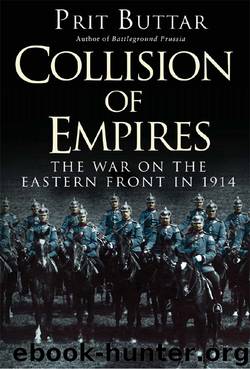
Author:Prit Buttar
Language: eng
Format: epub, mobi
Tags: Collision of Empires: The War on The Eastern Front In 1914
ISBN: 9781782009726
Publisher: Random House Publisher Services
CHAPTER 10
THE REALITY OF DEFEAT
GALICIA, SEPTEMBER 1914
The opening rounds of the fighting in Galicia had clearly gone in favour of Conrad and his armies, but in a contest against a heavyweight like the tsar’s army, there was still a long way to go. Two Russian armies had been defeated and driven back, but two others remained active. Moreover, neither of the defeated armies had been destroyed. Given the sheer scale of Russian mobilisation, they had suffered a setback, no more.
Stereotypes often exist for good reasons. The frequent description of the Russian Army as a steamroller was, in this case, entirely appropriate. Subtlety and daring might be beyond its expertise and skill, but given time, it could recover from tactical or even operational setbacks. Its sheer scale meant that, unless it was forced to deal with such setbacks across its entire front, it was able to mount attacks elsewhere that allowed its defeated elements time to regroup. And, as it now demonstrated, it was also perfectly capable of moving quickly, though this appears to have been very much dependent on local commanders.
In Galicia the weakness of the Austro-Hungarian position lay in the east. An entire army – Böhm-Ermolli’s Second Army – was still missing, either still deployed in the Balkans or languishing on painfully slow troop trains. The change in concentration areas to a more westward position was only partly reversed late in the day, and the remaining troops were still somewhat further west than originally planned. By contrast, the Russians had two powerful armies deployed for an early advance into eastern Galicia.
In the north, Nikolai Ruzsky’s Third Army concentrated around Rovno and Dubno, from where it was only a short march from Brody, with IX, X, XI, and XXI Corps, a total of twelve infantry divisions and four cavalry divisions. Like most of his generation, Ruzsky had served in both the Russo-Turkish War of 1877–78 and the Russo-Japanese War of 1904–05. In the latter conflict he had been the chief of staff of Second Manchurian Army. He had a reputation for caution, sometimes bordering on indecisiveness, but he was also a firm member of the pro-Sukhomlinov circle in the Russian Army, and owed his current post at least partly to Sukhomlinov. His caution would not have been a significant problem if his superior had been a suitably aggressive character, but Nikolai Ivanov, the commander of Southwest Front, also had ‘a certain penchant for hesitation’.1 Aware of this, Grand Duke Nikolai resolved to keep a close eye on matters, visiting Ivanov in Rovno on 18 August to ensure that the Southwest Front would conduct itself with appropriate vigour.
A little further south of Ruzsky, concentrating around Proskurov, was the Russian Eighth Army, commanded by Alexei Brusilov, with VII, VIII, XII, and XXIV Corps, for a total of ten infantry divisions and five cavalry divisions. In some respects Brusilov was a typical product of the Russian Empire, having been born to a Russian father and a Polish mother in Georgia. He would be
Download
This site does not store any files on its server. We only index and link to content provided by other sites. Please contact the content providers to delete copyright contents if any and email us, we'll remove relevant links or contents immediately.
The Radium Girls by Kate Moore(12028)
100 Deadly Skills by Clint Emerson(4925)
Rise and Kill First by Ronen Bergman(4788)
The Templars by Dan Jones(4689)
The Doomsday Machine by Daniel Ellsberg(4490)
The Rape of Nanking by Iris Chang(4211)
Killing England by Bill O'Reilly(4001)
Stalin by Stephen Kotkin(3965)
Hitler in Los Angeles by Steven J. Ross(3946)
12 Strong by Doug Stanton(3550)
Hitler's Monsters by Eric Kurlander(3342)
Blood and Sand by Alex Von Tunzelmann(3203)
The Code Book by Simon Singh(3189)
Darkest Hour by Anthony McCarten(3130)
The Art of War Visualized by Jessica Hagy(3007)
Hitler's Flying Saucers: A Guide to German Flying Discs of the Second World War by Stevens Henry(2754)
Babylon's Ark by Lawrence Anthony(2678)
The Second World Wars by Victor Davis Hanson(2524)
Tobruk by Peter Fitzsimons(2516)
